Wealthy parents provide their children with a rich cultivating environment. Their kids learn good habits and discipline. They learn to expect the best from themselves and others. When someone is unkind to them, they don’t sweep it under the rug and forget about it instead they talk to the person who was unkind to them. They learn to work with others to achieve positive outcomes. As adults they are able to invest themselves in worth while causes. They have self confidence and don’t second guess themselves. They are better equipped to lean into difficult relationships and to choose work things out.
Asking Questions

A child from this kind of background would be encouraged to ask questions when they don’t understand. Their parents and others have provided a framework for them to make mistakes and get back up again until they are successful. As foreigners in Hong Kong, there’s plenty of stuff happening around us that we don’t understand, but we are no longer a children. When we fall down their is rarely someone there cheering for us, “saying you can do it; get back up again.” It’s probably a good thing that we don’t always ask questions. I know for myself, I would surely annoy those around me, if I were always asking, “What did he or she say? Did they mean this? I think they said that?” No we might tolerate that from children, but we don’t generally accept it from adults.
Adult Foreigners
Unfortunately, as adult foreigners, we can’t go back and start over again in our country of choice. Instead we need to work with the person we already are where we are. Sometimes that will mean choosing to live with disapproval from those around us. They may say things like, “Oh its just the crazy foreigner trying to communicate”. “Hahaha he or she thinks they can speak Chinese/ Cantonese, Whatever”. Other times it will mean ignoring language materials that feels too overwhelming for us. Let me just stop here and say – You Can Learn a Language Later in Life. This article has an interview with my friend Hubert who successfully learned Cantonese at University in Hong Kong. You go Hubert. But still, how do you choose what to ignore and what to pay attention to? There is just so much out there and so little time. You have to do a cost benefit analysis. There are still many Cantonese dishes that I don’t know how to say, but I know the basic meats and vegetables. For me that is enough for basic ordering. However for a real food lover, it might not be enough. One question that comes to mind is, “Will such and such an activity help me do relationships better.” We need to be considerate of our family members, our colleagues at work and our social circles. In the end, life is about relationships.
Choosing Not to Use Google Translate

I’ve heard that schools don’t expect NET’s to read emails that are in Chinese. Years ago, I experimented with software that allowed me to read the emails in Chinese with a word by word English translation. Now that kind of software is more available, but it still takes a considerable amount of effort on the foreigners part to use it. Also in the past Google wasn’t there to translate every email at the click of a button. I am sure that this technology was available long before I started to use it, but honestly I wish that there would have been someone there who I had a personal connection with that could have pointed it out to me. It felt very much like I was on my own.
Left Out
The Cost and Privilege of Being Left Out
In the past, everyone just expected, oh the foreigner doesn’t read Chinese, therefore they can’t read these emails. Times have changed, foreigners don’t have that excuse any more. An English translation is there for them at the click of a finger, but as long as there is no personal connection or no need to know that information those emails will likely go unread. I think many foreigners will remain in the dark, while the locals look at their email screens. Why, many times, it just doesn’t apply to us and in a way maybe that is also our privilege. Local colleagues must spend hours on work related communication.
We can’t completely put ourselves in the locals shoes. They are in the know and we are not. They have confidence to talk with other colleagues about what is happening at school and many times in each others personal lives. Sometimes we might know a little bit about what is happening around us and even be able to have a conversation about it. But we are definitely not “fluent” in what is happening around us at our schools. I think cost of not being a local or not being fluent in Cantonese should be obvious. We are left out. Occasionally, someone will talk to us in English, but when that happens it is seldom a group conversation. They are usually talking to us individually. English is a foreign language here. However, I am not sure if what the local teachers have over us NET teachers is really worth the price they have to pay for it. I might feel differently, if I could see a lot of value being derived from their struggles, but from my current perspective, I have to say I am grateful for the privileges I enjoy as a NET. I am choosing not to care as much about many of the details the local teachers have to be burdened with. In this sense I am privileged.
Young People Are Also Choosing Not to Care

NET teachers aren’t the only ones asking what to care about and what to let go of. Young people are also asking it. Unfortunately, I think a lot of them are giving up on their education too early. Yes, teachers are there, but I think a lot of times they don’t feel that the teachers or for that matter there parents are really there for them. Many of them would say it’s too embarrassing to fall down/ make a mistake in front of my friends. They would rather not take the risk. They feel the potential loss: not being understood, being laughed at by their friends, being seen as a teachers pet etc… is too costly. Therefore they forfeit their opportunities to learn.
Caring About What’s Important

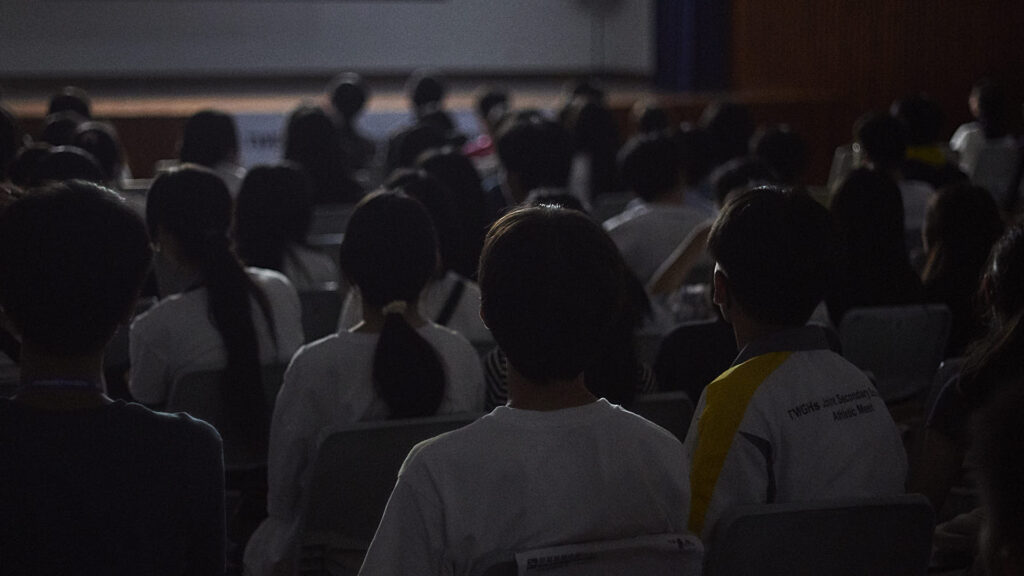
At the same time there are events, announcements, speeches etc… that I do want to know about. I don’t want to be in the dark. For example recently, my school had graduation for S6 students. A few class teachers and the vise principal shared. Some students also shared. This graduation ceremony represented something of the life of the school that I wanted to feel a part of. Thankfully I have some hobbies that helps me with such pursuits. I enjoy studying Cantonese and I shoot photos and videos. I wish I could tell you that after the first time of re listening to the teachers’ and vise principal’s speeches I understood everything. I didn’t; truth is I am still trying to figure it out. Each time I listen to it I feel like I get something new. What about you? How do you respond to these kinds of events? I try to tune in. Sometimes I ask questions to those around me. Here is an article on – Help From Others
Like Kids

I think this puts us foreigners in the same language category as children. Years ago I was going to a NET cluster meeting. There were several foreigners present and we didn’t know the way. There were two Chinese ladies. A few bold foreigners asked the Chinese some simple directional questions. The shy Chinese answered very matter of fact and we were on our way. Again adults were not able to do something that kids can do. This is humbling.
NET Teachers Eating Together

I think one of the dangerous messages NET’s may subconsciously receive from being left out of the school community is that they don’t belong or what they have to contribute is not really important. Of course, community requires a common language. So I am not referring to teachers teaching at international schools or necessarily EMI English as a Medium of Instruction schools. However, having a common language does not automatically mean there will be community. We can’t require others to accept us, make time for us, or be there for us. All of that is supposed to happen in our families of origin. If we get it there, we are blessed and will likely have an easier time finding it in other areas of life. Want to see how you would do in an all Cantonese environment check out – Coffee Activity.

Walk Through Open Doors and Be Thankful
But let’s go back to the graduation speech, what I understood. For example, the feeling of sadness to be leaving that is accompanied by the uncertainties of what is ahead. There was also the teacher’s encouragement to never give up and to stay in touch. It reminded me of graduation in the states and personal memories. I could identify. Also the fact that I was there to hear and appreciate the sharing in Cantonese made me feel a little bit closer to my school community. No, I am not really one of them, but I feel that I am walking through some of the doors that are open to me. I have chosen to learn Cantonese and now I am reaping some rewards from that decision. I care about my school community. I don’t need to care about many of the inner working details of how things are run. I think there will always be some separation, but I am grateful for what I do have.


I have been surfing online more than three hours today, yet
I never found any interesting article like yours.
It is pretty worth enough for me. In my view, if all webmasters and bloggers made good content
as you did, the internet will be much more useful than ever before.